 A memo to developers all over the world about the pronunciation of the word "apache".

Nowadays the interwebz abounds with beautiful images of our Earth from orbit. Lately I have picked up the habit of trying to figure out what part of our world is visible when I see such an image. It is usually quite a puzzle, since the scale of the picture is not always obvious, parts of it are always obscured by clouds, the North can really be anywhere, and worst of all, countries are not painted with different colors! (Duh!) I am usually successful in this, but today I had a real tough one.
Read more »If you live outside of Europe you might be lucky enough to have no idea what this is all about, but if you live in Europe you are probably sick and tired by now of this message popping up every time you first visit a site:
This site uses cookies to help deliver services. By using this site, you agree to the use of cookies. {Learn more} {Got it}
The creators of these sites are not to blame for these messages; they are being forced to display them against their will, (and waste money and resources in doing so,) in order to comply with EU regulations. These messages are mandated by law.
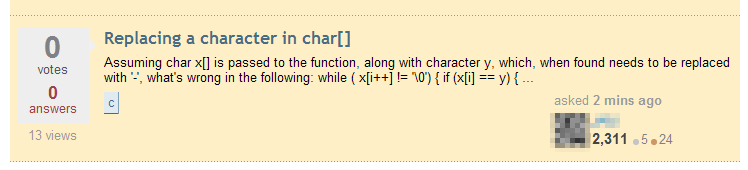
Read more »This question was sighted on stackoverflow.com on Thursday, April 30, 2013. It was deleted within 2 minutes from being posted, but not before I managed to take a screenshot of the summary.
It is funny when you can tell what's wrong with the code by just looking at the summary!
A few days ago one of the svchost.exe processes on my machine (Win7 64) started exhibiting this annoying behavior: it will start with about 30 to 40 megabytes of memory, which stays roughly constant for a while, but then later it begins bloating, slowly but surely, possibly at a slightly exponential rate, until a few hours later it is taking up so many gigabytes that I cannot work on my computer anymore. So, I have to stop what I am doing, save everything, and restart the computer, only to have to go through the same ordeal a few hours later.
Read more »
I had this happening on my development machine, (I use C# on VS2010) so I went over to The Code Project and asked if anyone else could reproduce it, and sure enough, it has been confirmed.
Steps to reproduce:
Create a new project, make it a C# console application, use all default settings. Open the generated Program.cs file and replace its contents with the following:
Read more »